

Attendance
Excellent attendance in school is vital for children’s learning, confidence, and wellbeing. Every school day builds on the last, helping children develop key skills in reading, writing, maths, and social interaction.
When children miss school, even occasionally, they can find it harder to keep up, which may affect their confidence and enjoyment of learning. Good attendance also helps children build positive routines, strong friendships, and a sense of responsibility that supports them throughout their education.
By working together to ensure children attend school every day, we give them the best possible start to their learning journey. You can find a copy of our attendance policy here.
If Your Child Is Absent You Must:
-
Contact school on each day of absence and provide reasons for absence.
-
Keep school informed on a regular basis if your child is absent for a long period.
- If you fail to contact us, we will contact everybody on your contact list. We have a safeguarding obligation to know where your child is.
Failure to do these things may result in your child’s absences being unauthorised
Unauthorised absences can be recorded on the register when there is no valid reason given for absences, a holiday not approved by the school, lateness after the register closes or illness without medical evidence.
The School Day
-
The school opens to the children at 8:40 am and the school day officially begins at 8:50 am.
- Register is taken at 8:50 am. Children who arrive after 9:05 am will be marked as late.
- If your child arrives at school any later than 9:25 am, an 'an unauthorised absence' mark will be recorded.
-
Keep school informed on a regular basis if your child is absent for a long period.
Other Key Information
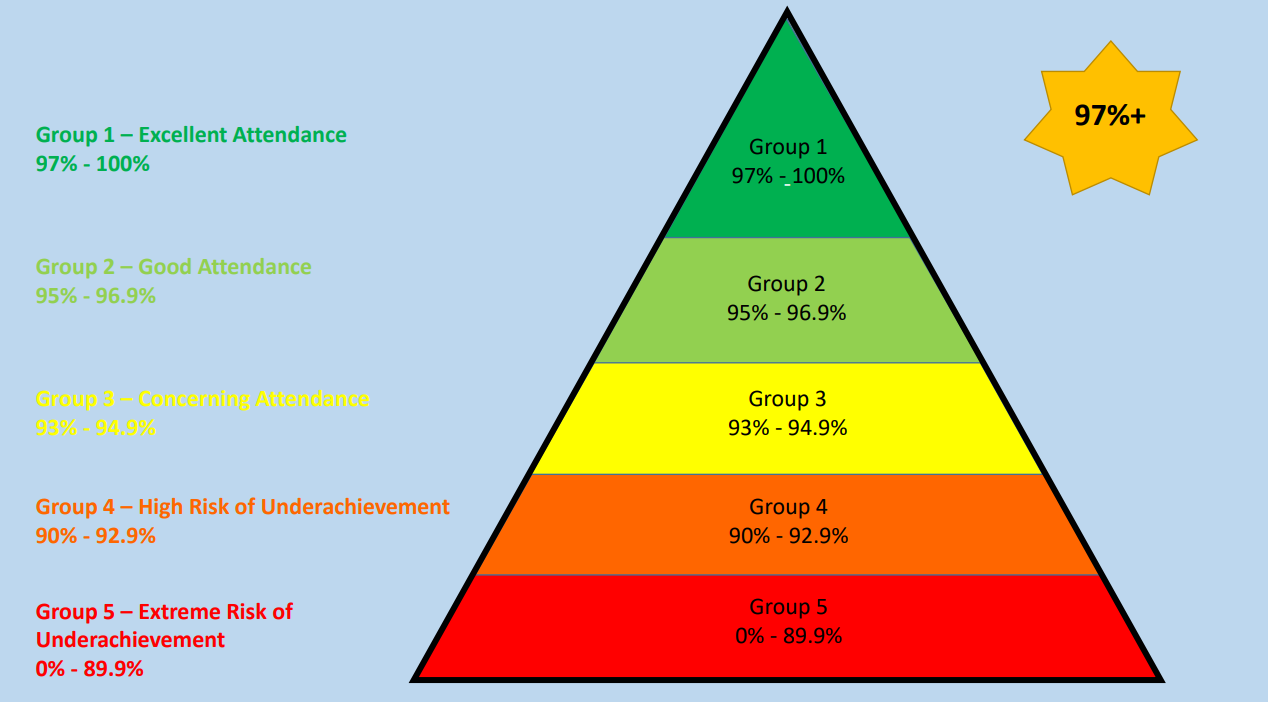
Please bear in mind that the significance of each percentage increases depending on how far into the academic year we are.
- We define 'excellent' attendance is anything about 97%.
-
Anything between 95% and 97% is deemed satisfactory.
- Attendance between 90% and 95% is below average and is of concern.
- Attendance below 90% is classed as persistent absence.
- Attendance below 50% is classed as severe absence.
How do we celebrate and promote good attendance?
- Each week, a child with 100% is randomly chosen to win a book voucher.
- The class with the highest attendance each week receives an extra playtime as a reward
- Attendance is highlighted in our weekly bulletin to parents.
- Each term, those children with good attendance are awarded certificates.
- At the end of the year those with good attendance are also given certificates.
- Each term, parents are sent an attendance summary that details attendance for the year to date.
How do we monitor attendance and what happens when my child's attendance falls?
Step 1
- Attendance is monitored on a daily basis by the headteacher and admin officer.
- Termly attendance data is produced and shared with governors.
- All parents receive an attendance certificate each term that details information about their child's attendance.
Step 2
- If attendance falls below the expected level, a letter will be sent to the parent. This is designed to alert the parent of dip in attendance.
Step 3
- Attendance for this child is monitored carefully. If it does not improve or continues to fall, the headteacher will invite the parent(s) into school for a first School Attendance Meeting (SAM). During this meeting we work together to look at barriers to attendance and to ways to overcome them.
Step 4
- If attendance continues to fall or does not improve, a second School Attendance Meeting will be organised.
Step 5
- If, following the second meeting, attendance does not begin to improve, the school may make a referral to the Education Welfare Officer (EWO). An EWO supports school attendance, works with families, addresses barriers, enforces legal duties, and promotes children’s educational wellbeing.
When Should I Keep My Child Off School?
Attendance Percentages – Days Absent
86% 27 days (5 school weeks and 2 days)
87% 25 days (5 school weeks)
88% 23 days (4 school weeks and 3 days)
89% 21 days (4 school weeks and 1 day)
90% 19 days (3 school weeks and 4 days)
91% 17 days (3 school weeks and 2 days)
92% 15 days (3 school weeks)
93% 13 days (2 school weeks and 3 days)
94% 11 days (2 school weeks and 1 day)
95% 9 days (1 week and 4 days)
96% 7 days (1 week and 2 days)
97% 5 days (1 week)
98% 3 days
99% 1 day
100% 0 days
Equamead Attendance Guide